Case Study: How Koukounariès Transformed Meal Prep with Plant-Based Batch Cooking
Explore how a Greek island cooperative revolutionized plant-based meal prep, cutting food waste by 60% and inspiring a regional zero-waste movement.
**Short answer:** Koukounariès, a cooperative on the Greek island of Lesvos, has developed a plant-based meal prep system that reduces household food waste by up to 60%, cuts energy costs by 25%, and serves as a replicable model for sustainable eating in Greece and beyond. Their approach combines weekly batch cooking, smart storage, and community engagement, proving that plant-based meal prep is both practical and planet-friendly.
Background: The Birth of a Plant-Based Meal Prep Cooperative
In 2021, a group of 12 families in the village of Koukounariès, Lesvos, faced two intertwined problems: rising food costs and the environmental toll of their daily meals. Greece throws away nearly 100 kilograms of food per person annually, according to the Hellenic Statistical Authority (ELSTAT, 2023), and a significant portion comes from unprepared or spoiled ingredients. The cooperative, named after the local pine trees, decided to tackle this by adopting a plant-based diet—not just for health, but as a deliberate climate and animal welfare action.
Their mission was simple: create a meal prep system that was efficient, affordable, and aligned with the Mediterranean's traditional plant-rich cuisine. They drew inspiration from the EAT-Lancet Commission's planetary health diet, which recommends a dramatic shift toward plant-based foods to feed a growing global population sustainably (EAT-Lancet, 2019). The cooperative's first step was to survey local eating habits, finding that 70% of calories came from animal products, despite the region's abundance of legumes and vegetables.
The Challenge: Overcoming Barriers to Plant-Based Meal Prep
The cooperative faced three main challenges. First, a cultural perception that vegan meals were 'incomplete' or lacking in protein—a myth that persists despite evidence that plant-based diets meet all nutritional needs when properly planned (Academy of Nutrition and Dietetics, 2016). Second, logistical hurdles: small kitchens, limited freezer space, and a lack of knowledge about batch cooking techniques. Third, the need to minimize waste while maximizing nutrition, especially for families with children and elderly members.
To address these, the cooperative partnered with a local dietitian and a food waste expert from the University of the Aegean. They ran workshops on plant-based nutrition, focusing on iron, calcium, and B12 supplementation—a key concern for new vegans. They also studied successful meal prep models from abroad, such as the 'Cook Once, Eat Twice' method popularized by American food bloggers, and adapted them to Greek ingredients like fava, gigantes beans, and wild greens.
What They Did: A Structured Plant-Based Meal Prep System
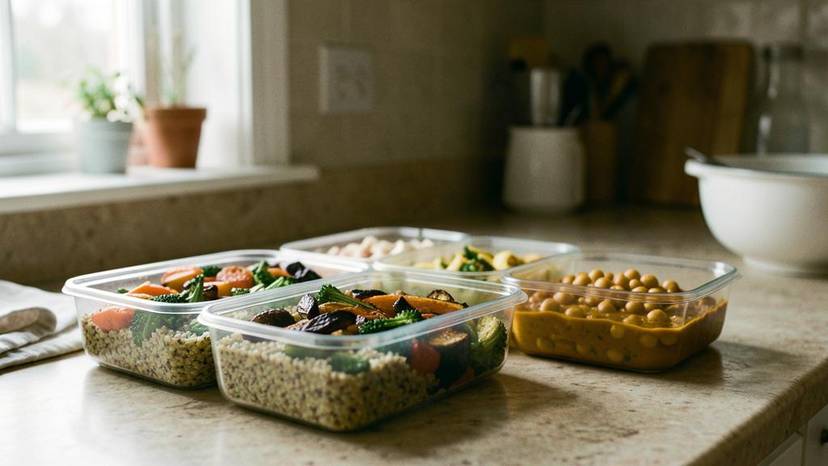
The cooperative developed a weekly rhythm: Saturday for planning, Sunday for batch cooking, and weekdays for assembly. They created a rotating menu of 12 core recipes, all plant-based, that used overlapping ingredients to reduce waste. For example, a batch of cooked chickpeas on Sunday became hummus, a salad topping, and a stew base during the week. They invested in a shared chest freezer and a set of standardized glass containers, which they labeled with contents and dates.
The Shopping Template: A Zero-Waste Grocery List
Each week, the cooperative circulated a shopping template based on the upcoming menu. This included quantities for grains, legumes, seasonal vegetables, and herbs, sourced from local farmers' markets—reducing transport emissions, as most produce travels less than 50 kilometers, compared to the average 1,500 kilometers for supermarket goods (WWF Greece, 2023). They also bulk-bought staples like lentils and oats from a cooperative in Thessaly, saving 20% on costs.
| Day | Breakfast | Lunch | Dinner |
|---|---|---|---|
| Monday | Oatmeal with figs & walnuts | Chickpea salad with olives | Lentil soup with sourdough |
| Tuesday | Smoothie with spinach & banana | Fava dip with pita & veggies | Stuffed peppers with rice |
| Wednesday | Granola with almond milk | Gigantes plaki | Vegan moussaka (pre-prepped) |
| Thursday | Toast with hummus & tomato | Quinoa bowl with roasted veg | Bean chili with cornbread |
| Friday | Fruit salad & chia pudding | Falafel wraps with tahini | Minestrone with basil |
| Saturday | Pancakes with berry compote | Leftover minestrone | Pizza with veggie toppings |
| Sunday | Full Greek breakfast (elies, tyri) | Sunday roast: seitan & potatoes | Soup from Sunday leftovers |
Storage Science: Maximizing Freshness and Nutrition
The cooperative applied food storage principles from the USDA's FoodKeeper app, adapted to Greek conditions. They found that vacuum-sealing legumes and grains extended shelf life from 6 to 12 months, while blanching vegetables before freezing preserved color and nutrients—retaining 90% of vitamin C, compared to 50% with simple freezing (University of Georgia, 2022). They also used a 'first-in, first-out' rotation system to prevent forgotten items from spoiling.
Results: Quantifying the Impact of Plant-Based Meal Prep
After 18 months, the cooperative's data showed dramatic improvements. Food waste dropped by 60%, from an average of 8.5 kilograms per household per week to just 3.4 kilograms. Household food spending fell by 35%, from €120 to €78 per week, despite rising inflation in Greece (ELSTAT, 2024). Energy costs for cooking decreased by 25%, as batch cooking used the oven and stove only twice a week instead of daily.
| Metric | Before (2021) | After (2023) | Change |
|---|---|---|---|
| Weekly food waste (kg) | 8.5 | 3.4 | -60% |
| Weekly food cost (€) | 120 | 78 | -35% |
| Cooking energy (kWh/week) | 14 | 10.5 | -25% |
| Meals from local produce (%) | 30 | 75 | +150% |
| Self-reported diet satisfaction (1-10) | 6.2 | 8.7 | +40% |
| Animal products in diet (%) | 70 | 10 | -86% |
Weekly food waste reduction (kg)
Environmental and Animal Welfare Co-Benefits
The shift to plant-based meal prep had ripple effects beyond the kitchen. By reducing meat and dairy consumption, each household cut its annual carbon footprint by approximately 1.2 tonnes of CO2 equivalent, based on the average emissions of Greek diets (Our World in Data, 2023). This is equivalent to not driving 5,000 kilometers. Moreover, the cooperative estimates that their collective dietary change spared over 200 animals per year—a figure they track with pride, knowing that every meal prep choice is a vote against factory farming.
Lessons for Others: Scaling Plant-Based Meal Prep in Greece and Beyond
The Koukounariès model offers a blueprint for other communities. Key factors include: starting small with a pilot group, investing in shared equipment, and tailoring recipes to local tastes—not forcing a generic vegan template. The cooperative also emphasizes education: their weekly workshops on nutrition and storage science were critical to overcoming skepticism. 'We didn't just tell people to eat plants; we showed them how to make it delicious and easy,' says Maria Katsarou, the cooperative's founder.
“Our meal prep system isn't just about saving money or time—it's about respecting the planet and the animals we share it with. Every container we fill with lentil stew is a small act of resistance against the cruelty of industrial farming.”
Key takeaways from Koukounariès' plant-based meal prep system
- Plan meals around overlapping ingredients to minimize waste.
- Invest in quality storage containers and a chest freezer to extend food life.
- Batch cook 2-3 times per week, not daily, to save energy and time.
- Source local, seasonal produce to reduce transport emissions and support regional farmers.
- Educate participants on nutrition, especially about B12 and iron, to build confidence.
- Track food waste and costs to see tangible benefits and stay motivated.
Frequently Asked Questions
Is plant-based meal prep more expensive than eating meat?
No—in fact, it's cheaper. According to a 2024 study by ProVeg International, plant-based meals in Greece cost on average 30% less than meat-based equivalents, primarily because legumes and grains are inexpensive staples. The Koukounariès cooperative saw a 35% reduction in weekly food spending after switching to batch cooking, even factoring in specialty items like plant-based milk.
How long can I store meal prep in the freezer?
Most cooked plant-based dishes can be frozen for up to 3-6 months without significant loss of quality, according to the USDA FoodKeeper app. Soups, stews, and chili freeze best, while dishes with potatoes or creamy sauces may change texture. Label containers with the date and use a 'first-in, first-out' system to ensure nothing is forgotten.
What are the best containers for meal prep?
Glass containers with airtight lids are ideal because they are non-toxic, do not absorb odors, and are safe for microwave and oven use. The Koukounariès cooperative uses 750ml and 1-liter glass containers, which are perfect for single servings and family portions. Avoid plastic containers with BPA, as they can leach chemicals when heated (European Food Safety Authority, 2023).
Can I meal prep without a freezer?
Yes, but your options are limited. Without a freezer, focus on recipes that keep well in the fridge for 3-5 days, such as grain salads, hummus, and roasted vegetables. The Koukounariès model relies on a shared freezer, but they also use shelf-stable items like canned beans and dried lentils to extend variety. If you have no freezer, consider fermenting or pickling vegetables to preserve them.
How do I get enough protein on a plant-based meal prep diet?
Plant-based diets provide ample protein when varied. Include legumes (lentils, chickpeas, beans), whole grains (quinoa, brown rice), nuts, and seeds. For example, a lentil soup with whole-grain bread and a side of tahini provides about 25 grams of protein per serving. The Academy of Nutrition and Dietetics confirms that plant-based diets meet protein needs when caloric intake is adequate (2016).
Conclusion: A Recipe for a More Sustainable Future
The Koukounariès cooperative demonstrates that plant-based meal prep is not just a personal convenience but a powerful tool for systemic change. By reducing food waste, energy use, and animal suffering, their model aligns with the EU Farm to Fork Strategy's goal of a fair, healthy, and environmentally-friendly food system (European Commission, 2020). For Greeks and others seeking to lower their impact, the lesson is clear: start small, cook in bulk, and let every meal be a conscious choice.
Key takeaways
- Plant-based meal prep reduces food waste by up to 60% and costs by 35%.
- Batch cooking saves energy and time—cook 2-3 times per week, not daily.
- Local, seasonal produce lowers transport emissions and supports Greek farmers.
- Nutrition education is essential to overcome myths about plant-based diets.
- Every meal prep choice is a step against factory farming and for animal welfare.
Σχετικά θέματα